
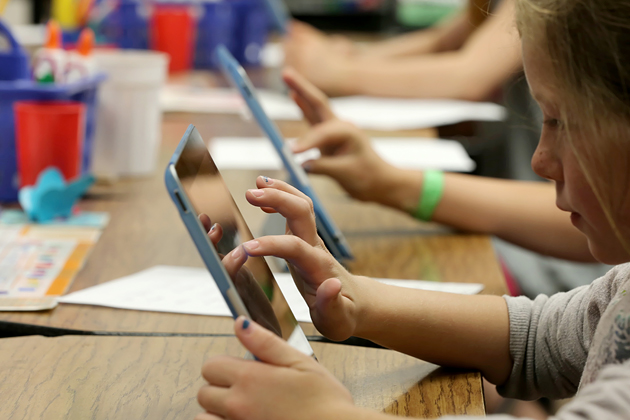
Technology will not replace great teachers but technology in the hands of great teachers can be transformational.
George Couros
Technology continues to be a hot topic in education; every educator, student, parent, and stranger on the street has a passionate opinion. Yet, no matter any individuals’ thoughts, there is no denying that technology is a growing aspect of education. Some technology is so familiar it hardly counts: calculators, desktops, projector screens. But iPads, chromebooks, smartboards, and even in-class cell phone usage are tools that are gradually entering classrooms across the nation. Without a doubt, technology has had a strong impact on every student’s learning experience, both positively and negatively.
I grew up in a technological explosion. I watched my classrooms transition from chalkboards to whiteboards, rolled in projectors to smart boards, and shared resource books to individual laptops. Every year, my district introduced another technological invention, leaving my teachers struggling to figure out how to connect touchpads to screens while at the mercy of twenty impatient middle schoolers. It was easy for my classmates and I to adjust to new technology as it became second nature to mess around with it until it started working. I learned how to Google any questions I had if my relentless changing of settings didn’t result in what I wanted. But most of my teachers were unsure how to effectively use the barrage of resources being thrown at them.
Personally, I enjoyed having so much technology to learn. I distinctly recall many assignments geared to teaching me how to use the internet to find academic sources. While most teachers still required us to use “old-school” methods occasionally, having the ability to skip through the tediousness of making photocopies of short sections from twelve different books, all for one paper, was much appreciated. I didn’t have to rely on outdated information or only trust one author’s opinion; we were expected to check our facts and quick confirmation was a saving grace. One of the best moments was when my teacher would announce we would be using clickers or playing a Kahoot to check our understanding. I cannot imagine what my education would have been like without the use of Powerpoint, Youtube, graphing calculators, and so many more essential tools in a twenty first century classroom.
Even with my great appreciation for this technology, its flaws are equally evident. As I mentioned before, it can be difficult to find the best ways to implement ever-changing technology into certain classrooms. Not every teacher is properly trained in how to use the new tools which translates into confusing assignments, incorrect directions, and a feeling of stress when plans don’t work out for both students and teachers. There is the obvious cost of these resources; some schools allocating an exorbitant amount of budget to buying the newest improvements while other schools struggle to afford more than two computer labs. Another common issue is technological malfunctions. More dependency put onto technology means more reliability is absolutely essential for successful lesson plans and functioning classrooms. Some circumstances are out of students’ and teachers’ control, such as internet outages or Google Drive going down. While incredibly frustrating, there will always be some unavoidable difficulties when relying on technology.
Technology’s benefits far outweigh its faults by providing innovative ways for teachers and students to connect to the modern world. I, along with millions of other students, will forever be grateful to have experienced this revolution of technology. English teachers may gripe about Sparknotes, but love the ability to have students create videos reenacting literatures greatest scenes. Math teachers refuse to allow students to use calculators to multiply but take advantage of the computer’s ability to graph functions in seconds. Science teachers can present videos of experiments they could never find the supplies to perform. Every teacher, when equipped with the right skills and knowledge, can make incredible and effective use of every new invention to keep students engaged and excited to learn.
 Jessica's Blog: The Learning Curve of Teaching